

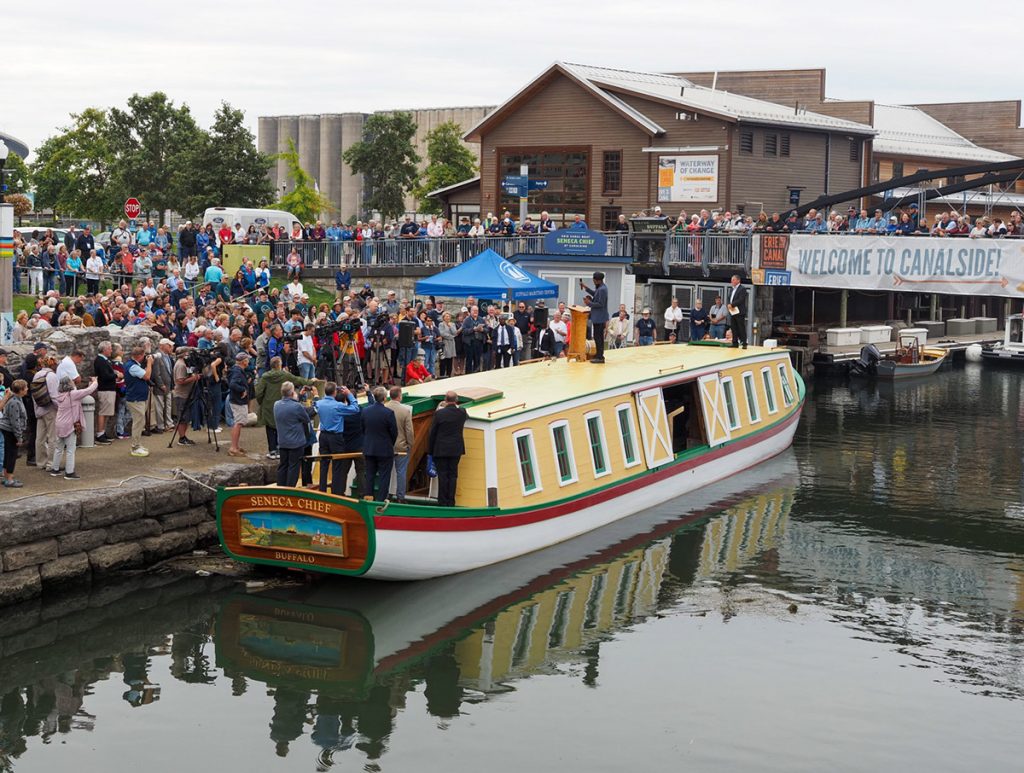
WCC delegates celebrate the departure of the replica Seneca Chief as it leaves Buffalo, heading to New York Harbor and retracing the route of Governor DeWitt Clinton’s 1825 flotilla. Like the original, the boat carried a barrel of Lake Erie water to be poured into the Atlantic, this time supplemented by water collected at each stop along the way. It also carried white pine saplings, symbolizing the Haudenosaunee Great Tree of Peace, to be planted in each of those canal and river ports.
The opening session was addressed by New York State Governor Kathy Hochul, a Buffalo native and a keen advocate for the NYS Canal System. Governor Hochul noted that canals are places of imagination and unlimited possibilities, enabling the flow of ideas as well as people and goods. She emphasized that investment in waterways is key to linking people with their communities.
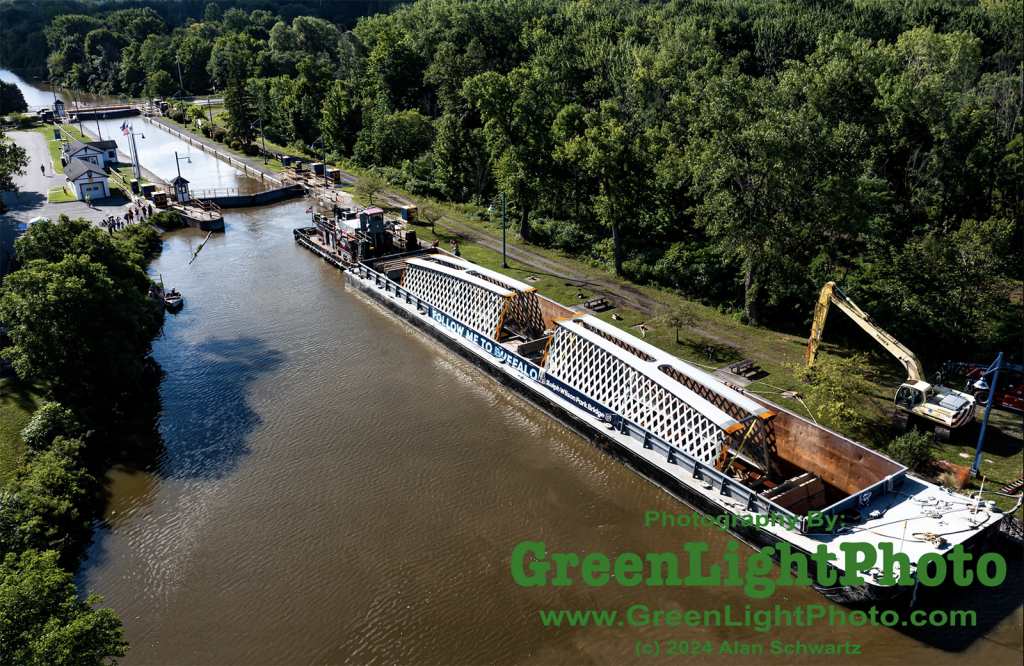
Kal Wyskowski, Chair of the Erie Canalway Natural Heritage Corridor Commission introduced a dramatic video that traced last year’s journey of a new bridge from Italy to Ralph Wilson Park in Buffalo. It travelled across the Atlantic, up the Hudson River, and along the Erie Canal, demonstrating how water transport can carry large loads without causing hold-ups on road systems.
The next session highlighted impacts of the Erie Canal on indigenous people, a theme that was continued throughout the conference. J. C. Seneca, President of the Seneca Nation of Indians, reminded delegates that they were sitting in Seneca territory and that the Erie Canal crossed lands taken from the Seneca, Cayuga, Onondaga, Oneida, and Mohawk nations of the Haudenosaunee (Iroquois) confederacy. Despite the effects on his people, President Seneca was upbeat, looking forward to the future of the waterway, while taking into account the heritage and present-day needs of his people.
Other Keynote speakers on the opening day included IWI President Sharon Leighton; Brian Stratton, Director of the NYS Canal Corporation; Vincent Esposito, Vice-President of the Empire State Development Corporation. Zhang Futang, Vice-Chair of the World Canal Cities Organization, based in Yangzhou, Jiangsu, China, talked about the global network of inland waterway organizations and WCCO’s partnership with IWI. Angela Zabojnik from Leipzig, Germany, reported on progress in transforming former mining landscapes to waterway facilities. Richard Millar of Scottish Canals described how Scotland’s canals are being repurposed to support changing societies and environments. Plenary sessions on Thursday utilized panel discussions to focus on ways to improve access to canals for people of all abilities and canalside trails.
There were a total of eighteen breakout sessions, divided among five themes: Trends in Waterway Tourism and Recreation; Inclusion and Accessibility; Waterway Management; Canals and Historic Preservation; and Healthy Waterways, Healthy Communities.
Conference study tours explored canal communities, structures, and projects in western New York and nearby Canada. Delegates could choose to cross into Canada to visit the Welland Canal, a ship canal that bypasses Niagara Falls to link lakes Ontario and Erie; or visit North Tonawanda, the westward end of today’s Erie Canal, and various combinations of Lockport, Fairport, Medina and Brockport along the Erie Canal.
Lockport is an iconic site where locks of the Enlarged Erie and Barge canals climb the Niagara Escarpment side-by-side through parallel sets of staircase locks. Barge Canal locks E34-35, with a combined lift of 49 feet, were completed in 1915, replacing one set of Enlarged Erie locks 67-71. The northern 5-lock staircase was retained as a spillway. Timber gates are being installed to simulate their original hand operation.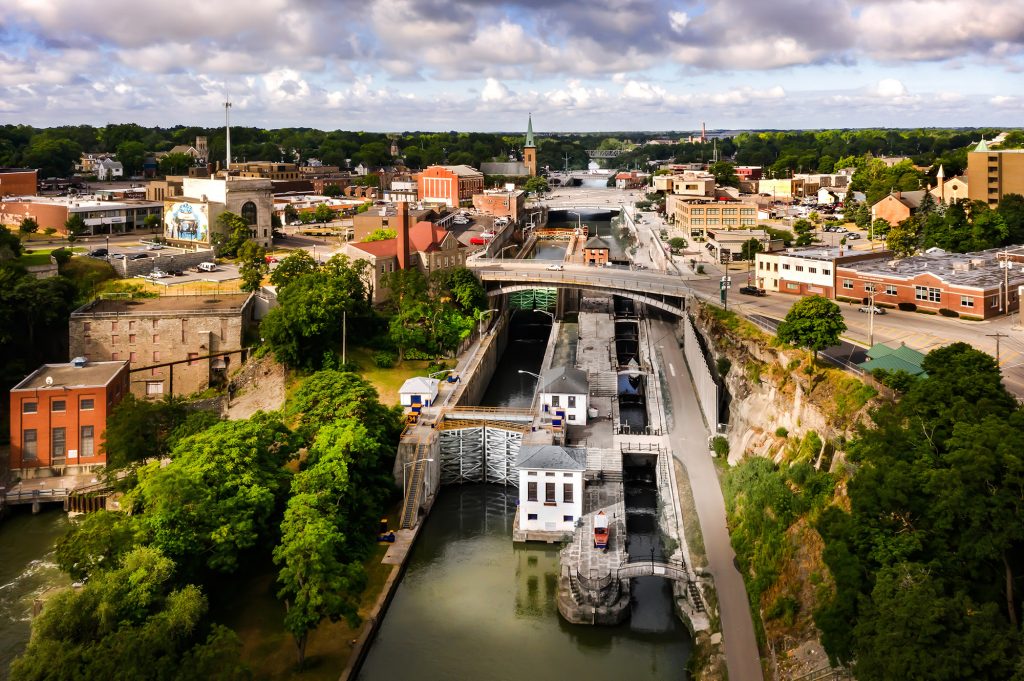
The final act of the conference was the traditional WCC handover from Bob Radliff, Executive Director of Erie Canalway National Heritage Corridor and Brian Stratton, Director of the New York State Canal Corporation, to the Sun Huanzhi, Vice Mayor of Guilin and chair of the organizing committee for WCC2026. Delegates saw previews of the 2026 conference, focusing on the Lingqu Canal, built to link the Xiang and Lijiang rivers, tributaries to the mighty Yangtse and Pearl rivers.
Janet Gascoigne